From layers to a release
The same path as the live manager: layers, a package, Release with its labelled links, then its states.
The factory ontology
One typed model of what a software company does, from planning a product to retiring it, written so that AI agents and people can work from the same picture.
Numbers as of 16 October 2026, read from the ontology's source files.
The film
Silent. How it is built, the manager, a year of sample data and the tool mappings.
The problem
Not without a shared model of the company around the code: what a release is, who approves it, and which steps need a person.
Each tool has its own idea of a release, an incident or an approval.
Who decides, and when a person must agree, sits in wikis and in people's heads.
Without a model, nobody can test whether an agent did the right thing.
The idea
People give the intent and answer four kinds of question. Agents do the rest, and record why for every decision they take. Both read the same model.
People
Intent and the four stops
The ontology
One model, read by both
Agents
Plan and design
Agents
Build, review, merge
Agents
Release and run
The split
A target, not a measurement. The sample company runs at 98.5 percent agents today, which is too high.
The four stops: the only times a person is asked
The ontology
The four core layers are locked and change only by proposal. Tools and company rules sit above them and never edit them.
Rules for a context
Company or country rules. They only make rules stricter.
Tools and methods
One package per tool, cloud or method, mapped onto the core.
40 mapped 44 discovered
Departments
40 packs, from billing and legal to incidents.
Software engineering
Releases, code changes, deployments, incidents.
Any company
People, organisations, agreements, money, risk.
Building blocks
The kinds: object, link, action, decision, state machine, policy.
Source
One YAML file per package, in git. The only thing anyone edits; everything else is generated.
19 checks
Automatic gates across files. Every state has a way out; every stop can be checked by a machine.
An independent reader
A fresh model reads only the generated documents and answers set questions. A separate model scores it.
Lock
Then the layer is locked. A breaking change fails unless the owner decides it.
The manager
Layer, then package, then type, then its states. Never more than a handful of things at once. The live manager is behind sign-in, so these are recordings and screenshots.
The same path as the live manager: layers, a package, Release with its labelled links, then its states.
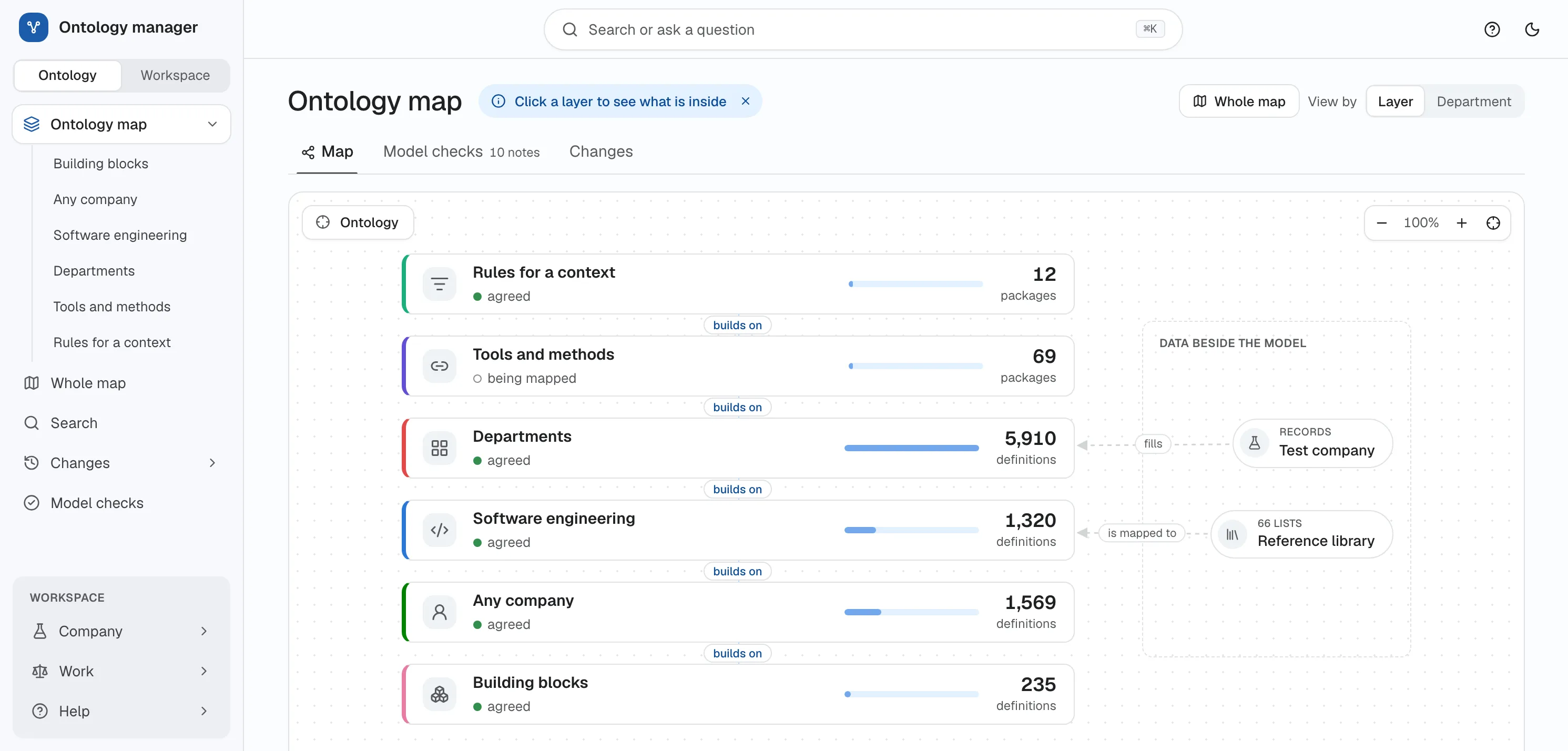
The home page: six layers and what builds on what.
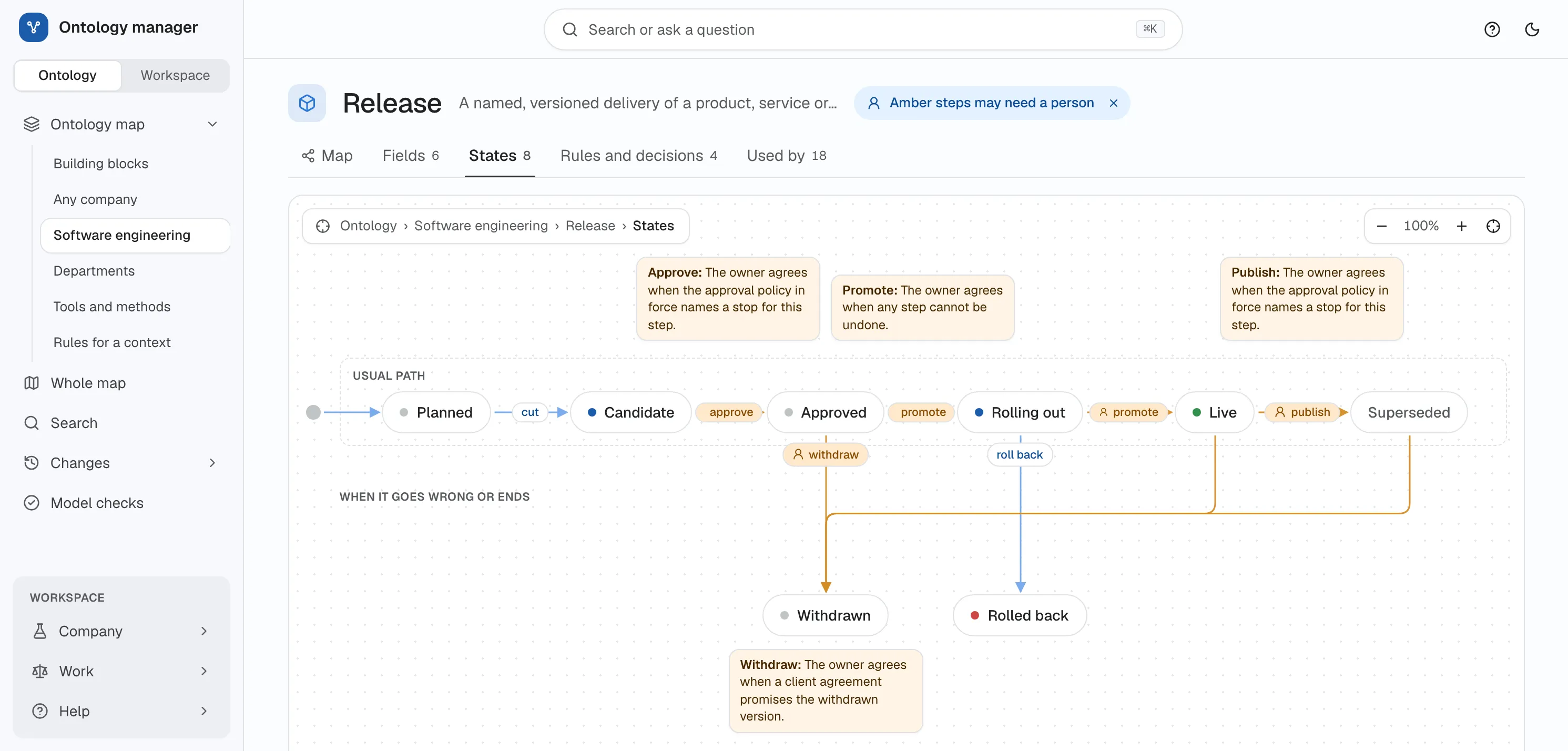
Planned to live. Amber steps may need a person, with the condition printed beside them.
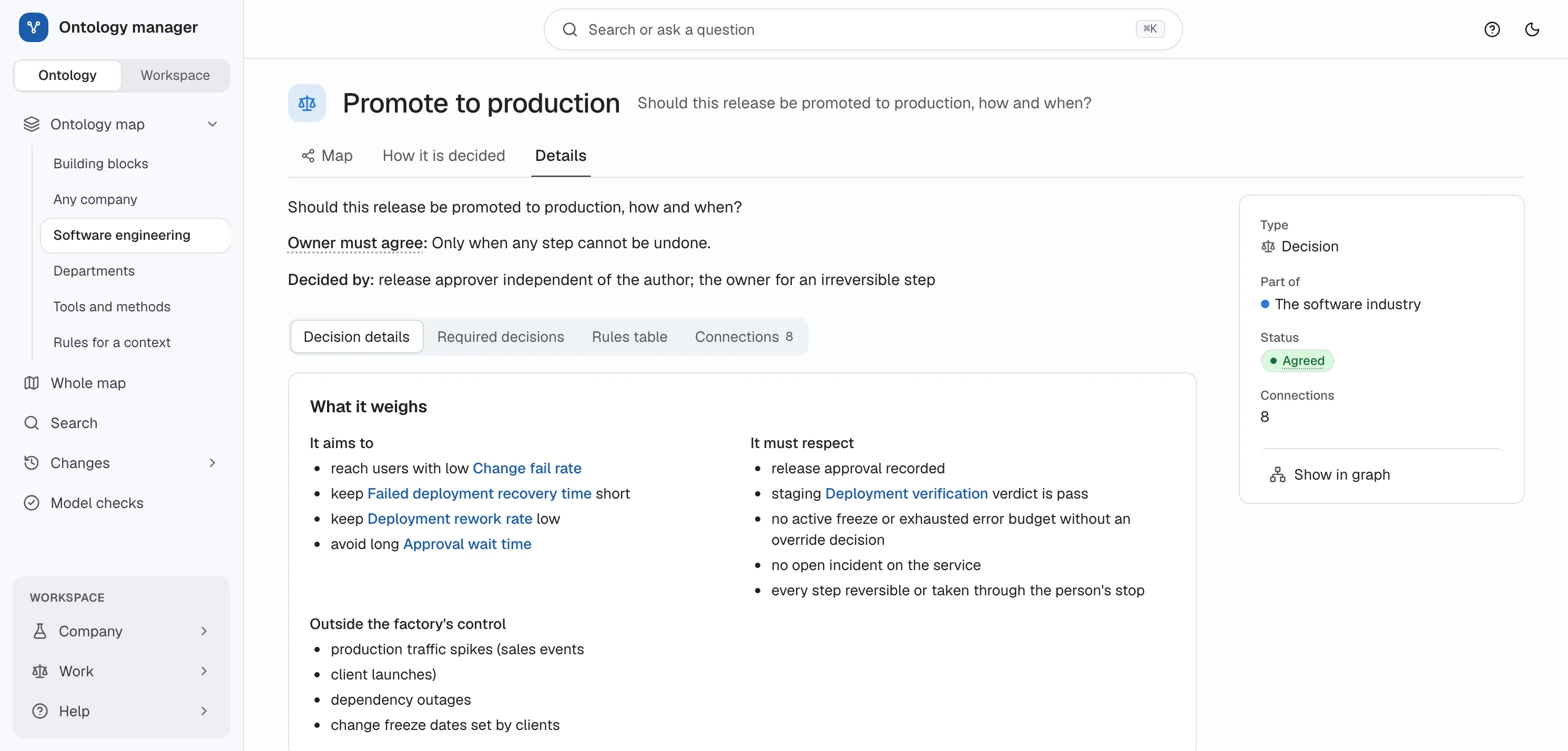
Promote to production: what it aims at, what it must respect, and what could change the answer.
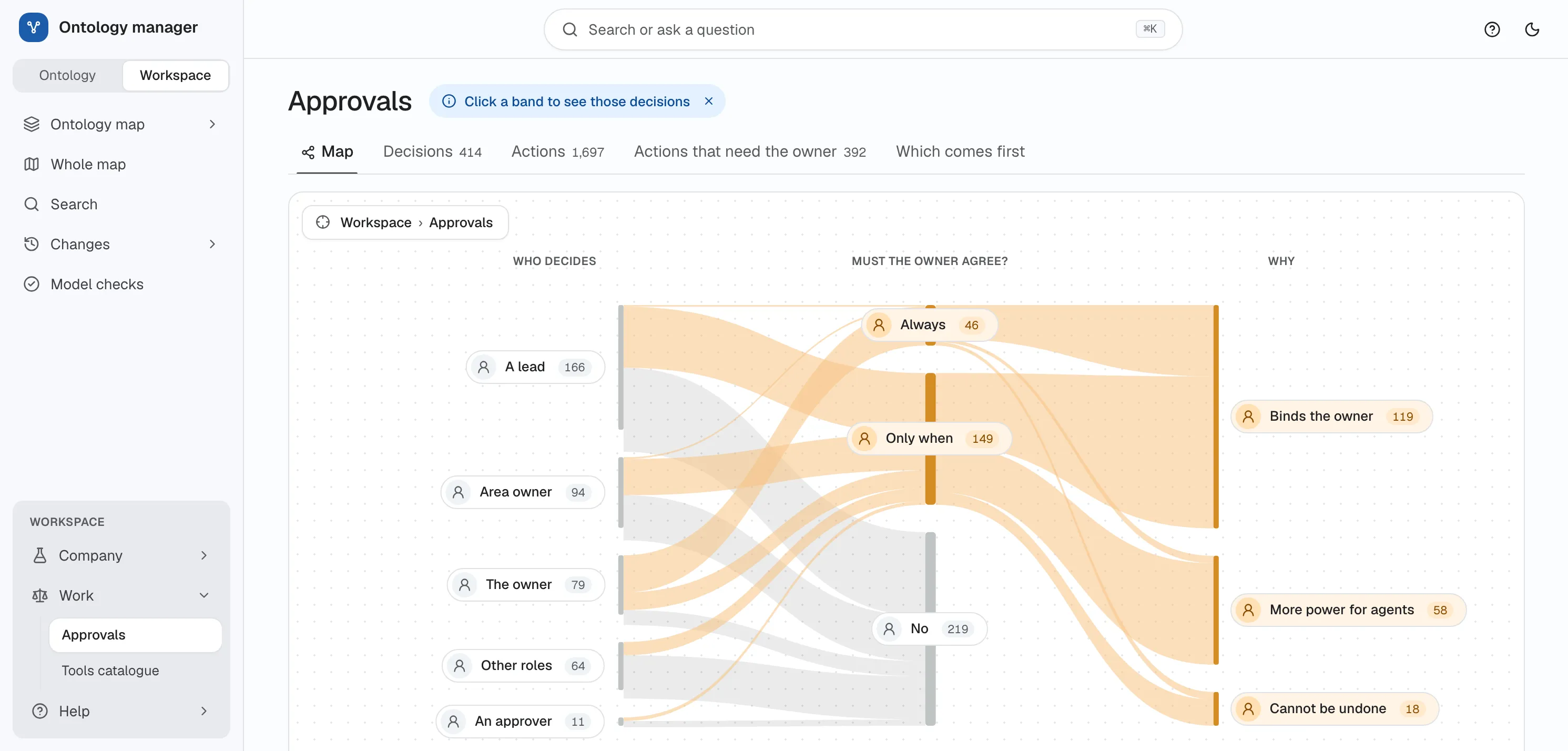
The owner must always agree on 46, only under a stated condition on 149, never on 219.
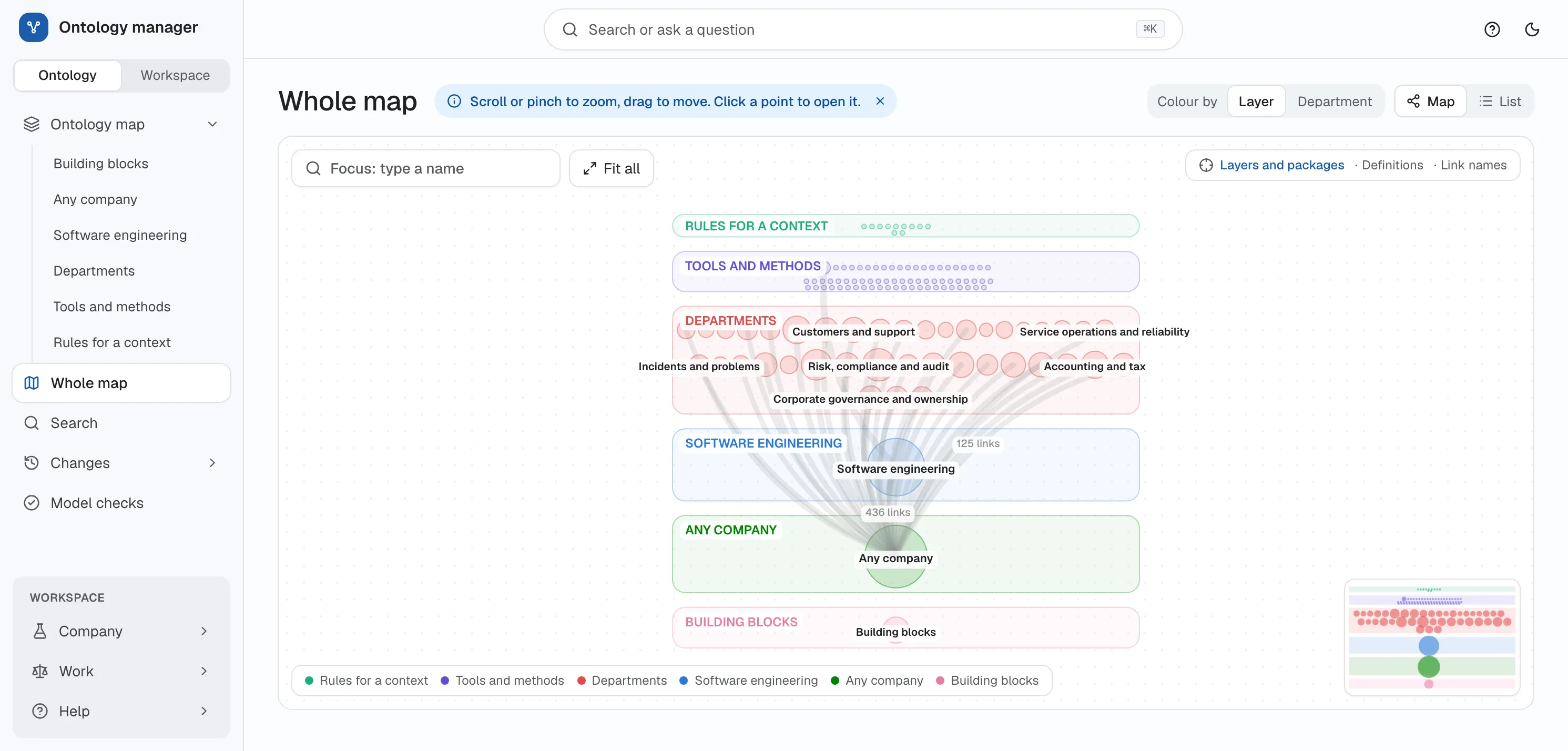
Everything at once, zoomed like a city. Search flies to any type.
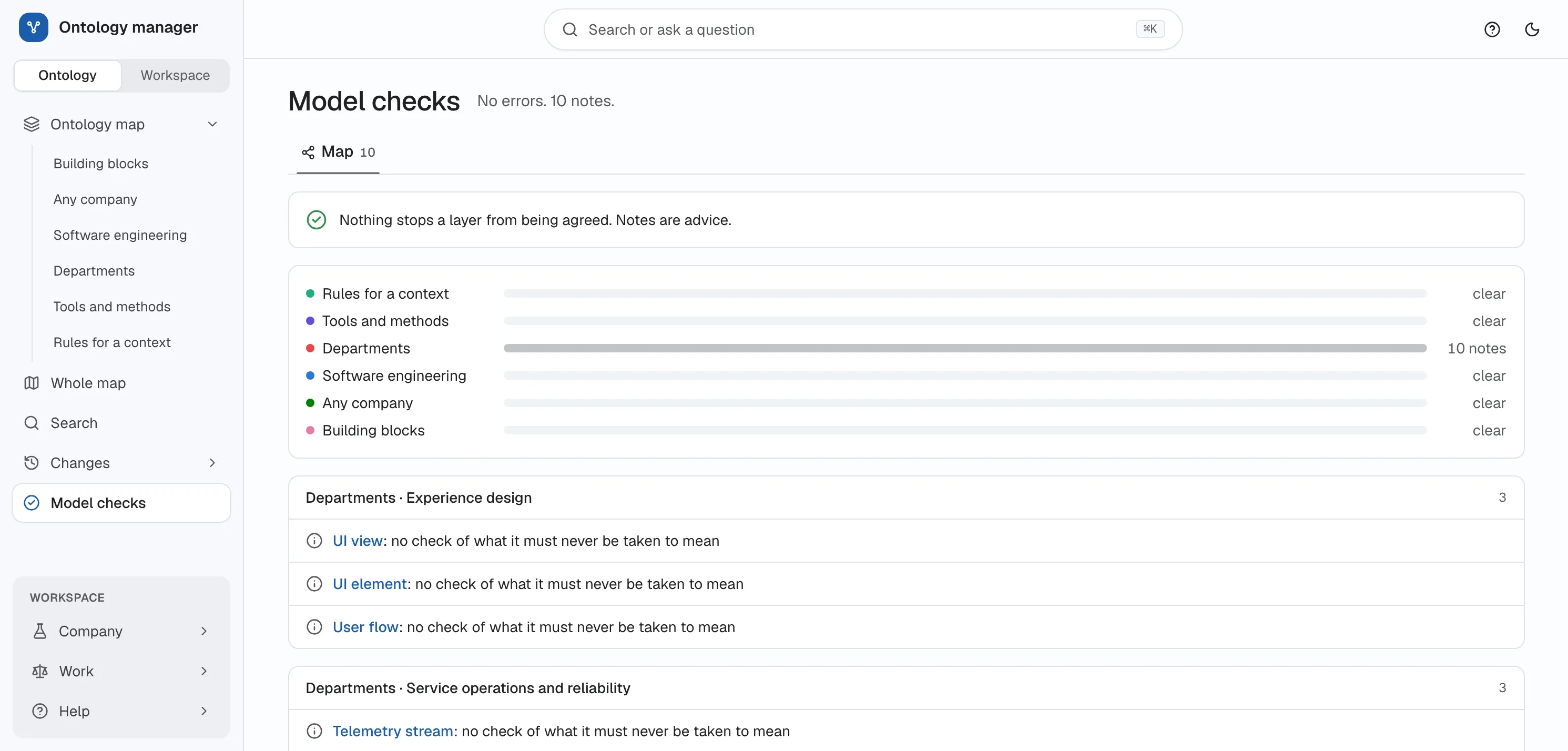
What the automatic gates found, layer by layer.
Screenshots taken on 15 October 2026. Counts inside them can trail the numbers on this page, which are read from the source files.
Proof
An agent with no context reads only the generated documents and answers questions written beforehand. A separate agent scores the answers. A layer is locked only after it passes.
Pass mark 80 percent. When a question's expected answer was itself wrong and the reader followed the source, it counts as correct (layer 1: 1, layer 2: 2, rules: 2).
Animation from an earlier run. The numbers below are the latest.
45 people and 216 agents over 12 months. Every record went through the model's own actions, state changes and links. When the model could not express something, the generator logged a gap.
119 gaps were logged in the latest run (1 major, 118 minor), none blocking. A second, tiny company ran beside it, and the one deliberate attempt to link records across the two was refused. Volumes come from a random walk, not real rates, so treat them as a test, not a forecast.
A slice of each standard's core model was written using only the building blocks and the enterprise core. Every probe is met natively. The first run found one gap, FHIR's choice of types, and the kernel gained one base type for it.
Any tool stack
The model never names a tool. Each tool, cloud or method gets a package built from its own published schema, mapping its words to the model's.
Pull request
GitHub
Merge request
GitLab
Code change
One term in the model
Read from the package registry of 2026-10-16.
A mapping climbs only when the tier below it passes.
Capped sandbox
Create, check and delete in a real account with a spending cap.
Real cloud, look-only
List and describe with a read-only identity; never change anything.
The real product, locally
Self-hosted products, a local Kubernetes cluster and a cloud emulator.
Offline
Every mapping against the tool's published schema and real documents.
Animation from an earlier run. The numbers beside it are the latest.
Honest status
The model, the manager and the sample data are real. The agents that will run on the model, and the factory core around it, are specified or planned, not built.
Built
In progress
Planned
About
Venkatesan Ramachandran designs and directs the factory: the research, the decisions and the reviews. Claude Code writes every line, under those decisions and the checks shown above.